
One perception core for every road.
WIDAR fuses camera, radar and lidar into one real-time world-view for automotive safety, and runs key stages bit-exact on WIOWIZ's own RTL.
The loop above is camera frames driven through our own CNN accelerator RTL. WIDAR fuses camera, radar and lidar so perception holds through the edge cases where a single sensor fails: night, glare, occlusion and sensor blinding.
The road breaks single-sensor perception.
Real driving is a stream of edge cases. A camera loses the pedestrian in oncoming headlight glare, a tunnel mouth, or a low winter sun. Fog and heavy rain wash out vision entirely. A cross-traffic cyclist appears from behind an occluding van with barely a second to spare. Safety cannot rest on one sensor that fails exactly when the scene turns dangerous. It has to come from sensors that cover for each other.
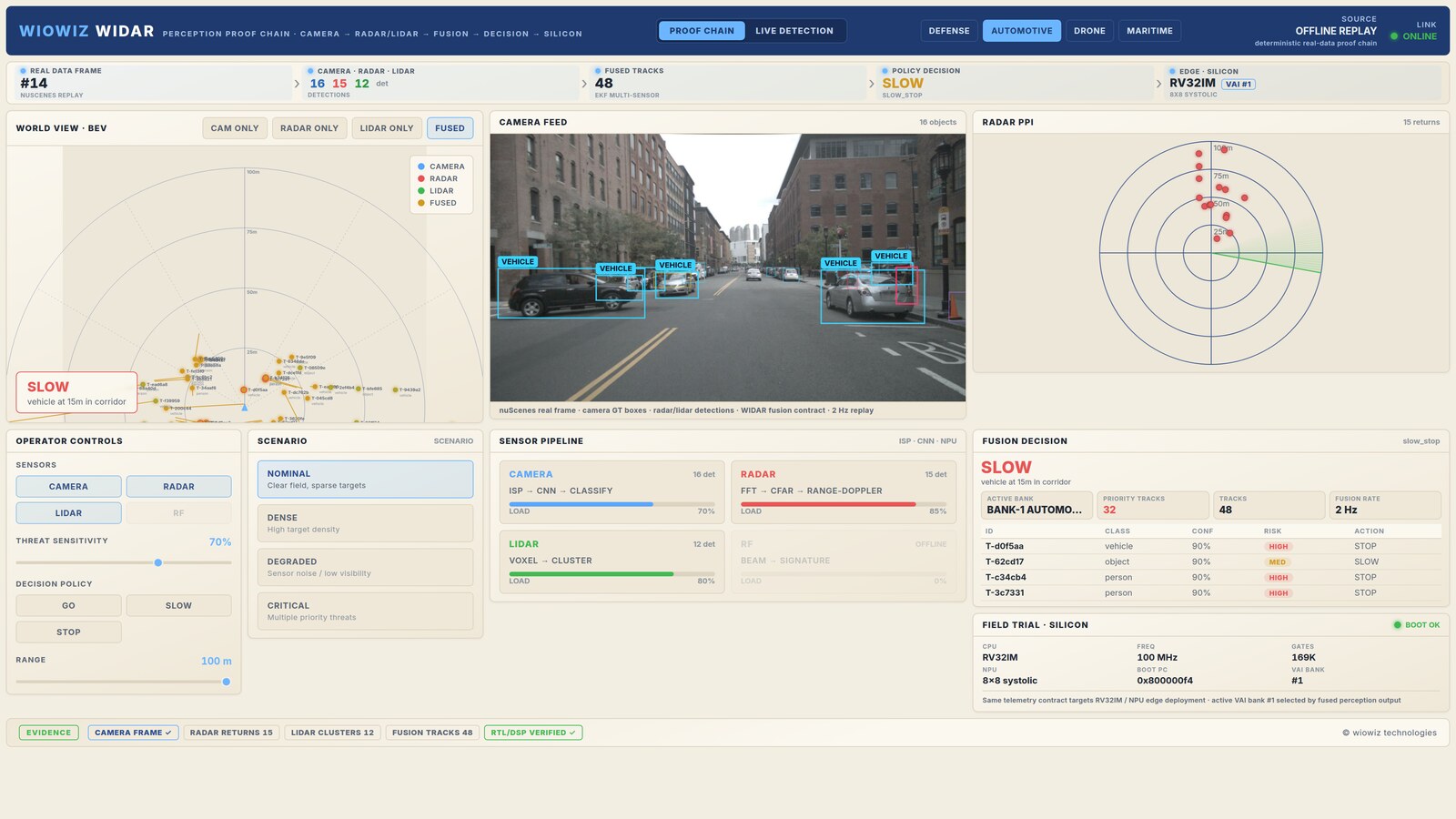
One world-view, fused from three senses.
WIDAR fuses camera, radar and lidar into a single bird's-eye world-view and one driving decision. Where one sensor is defeated, the others carry the track. Camera gives class and shape but fails at night or in glare. Radar sees through darkness, rain and dust and gives range and velocity. Lidar gives precise 3-D structure and separation. Cross-checked together, perception degrades gracefully instead of failing hard.
Camera
Class and shape: lane markings, signs, pedestrians and vehicles. The first to fail in glare, tunnels or darkness.
Radar
Range and closing velocity through rain, fog and night. Coarse alone, decisive in fusion, and processed on our own DSP RTL.
Lidar
Precise 3-D structure and separation of close obstacles, anchoring the fused world-view in real geometry.
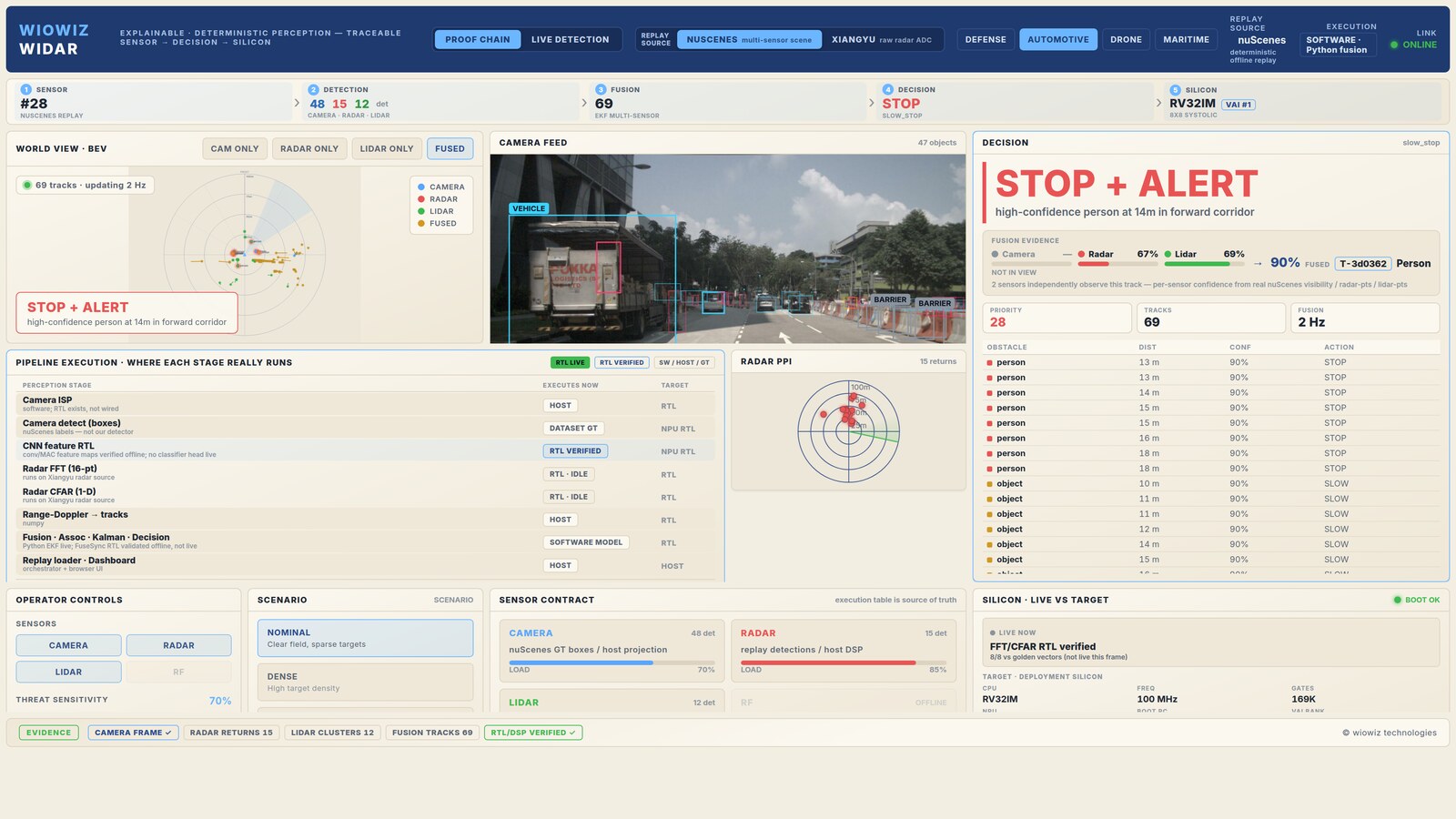
From sensors to a single decision
Each detection from each sensor is associated and tracked through a multi-sensor Kalman filter, then reduced to one driving picture: fused tracks, per-track confidence, and an explicit action per obstacle (GO / SLOW / STOP + ALERT). The pipeline is deterministic and traceable. Every stage reports where it actually ran, on host software or on RTL.
See the stack run.
WIDAR perception drives on scenario data and on the VAI architecture. Where a stage runs bit-exact on WIOWIZ RTL, we mark it. Tags are literal: RTL SCENARIO FUSION
CARLA + VAIDAS integration
Our ADAS perception inference running on the VAI architecture, driving a scenario through the CARLA environment: detection and tracking of road agents feeding one driving decision.
Detection on our own CNN accelerator RTL
Camera frames drive through WIOWIZ's own CNN accelerator RTL, frame by frame, with feature maps verified bit-exact versus the golden model. This is the perception front end running in our silicon.
Every agent fused into one driving picture
Camera, radar and lidar detections fuse into a single bird's-eye view, reduced to one decision (STOP + ALERT) with per-track confidence. The panel labels each stage's execution target.
Perception that holds when vision does not
In low light and glare, radar and lidar keep range and structure on every obstacle while the camera contributes what it can. Fusion carries the track through the exact conditions that break single-sensor systems.
Automotive perception belongs in silicon.
An ADAS core has to hold a fixed power and latency budget in the car, every frame, every drive. That is a silicon problem. In WIDAR, key perception stages do not just run in Python; they run bit-exact on WIOWIZ-designed RTL, checked frame by frame against golden reference vectors.
The path from perception to an automotive-grade edge device is a hardware path we already own, because we designed the accelerators, the DSP and the RISC-V control ourselves.
- Radar signal chain on our DSP RTL FFT, CFAR and range-Doppler, Verilated, bit-exact vs golden vectors.
- CNN feature extraction on our accelerator RTL Camera frames through a WIOWIZ CNN accelerator; feature maps verified bit-exact.
- RISC-V control at the edge An RV32IM core with an 8x8 systolic NPU as the deployment target for on-chip inference.
- Deterministic, traceable pipeline Every stage reports its execution target, host software or RTL.
Where WIDAR for ADAS is going.
WIDAR runs a full camera, radar and lidar fusion pipeline today, with RTL-backed stages and ADAS inference on the VAI architecture. Here is the ladder to a car-grade edge system.
Fusion and RTL perception
Camera, radar and lidar fusion into one driving decision. Radar DSP and CNN feature stages verified bit-exact on WIOWIZ RTL, with ADAS inference on the VAI architecture.
Live sensors and our own simulation
Run the same pipeline on live automotive mmWave radar, lidar and camera, and stand up our own scenario simulation to train and validate perception across edge cases.
On-chip end-to-end inference
The full detect, track and decide loop running on WIOWIZ silicon in the vehicle, within a fixed automotive power and latency budget.
Request a WIDAR for ADAS briefing.
We walk automotive teams through the fusion pipeline, the RTL-verified stages, and what a path to your own in-car edge silicon looks like. Not slideware: the stack running.