
One perception core. Every front.
WIDAR fuses camera, radar and lidar into one real-time world-view and runs it on WIOWIZ silicon. One core, aimed at four fronts: physical robots, ADAS, drones and agriculture.
The loop above is camera frames driven through our own CNN accelerator RTL. The same fusion core powers every WIDAR vertical, from the contested sky to the drying line.
What WIDAR is, and why we build it
WIDAR is WIOWIZ Intelligent Detection And Ranging. It fuses camera, radar and lidar into one perception picture and turns it into a decision. As a hardware company, we build perception models in hardware, ready to run on FPGA and SoC. We model the AI as RTL, verify it bit exact against golden, and run it on our own accelerators. Perception that runs in silicon, not only in software.
Build the perception core once. Aim it everywhere.
A drone in a contested sky, a car on a dark road, a robot on a factory floor and a crop on a drying line are different missions with the same underlying problem: fuse imperfect sensors into one trustworthy world-view, decide in real time, and do it inside a fixed power and latency budget. WIDAR solves that problem once, in a fusion core that runs on our own silicon, and points it at every front.
Three senses in. One world-view. Four fronts out.
Detect, associate and track across sensors into one bird's-eye world-view and one decision. Key stages run bit-exact on WIOWIZ-designed RTL.
One platform, four missions.
Each front runs the same fusion core, tuned to its world. Follow any of them into its own page.
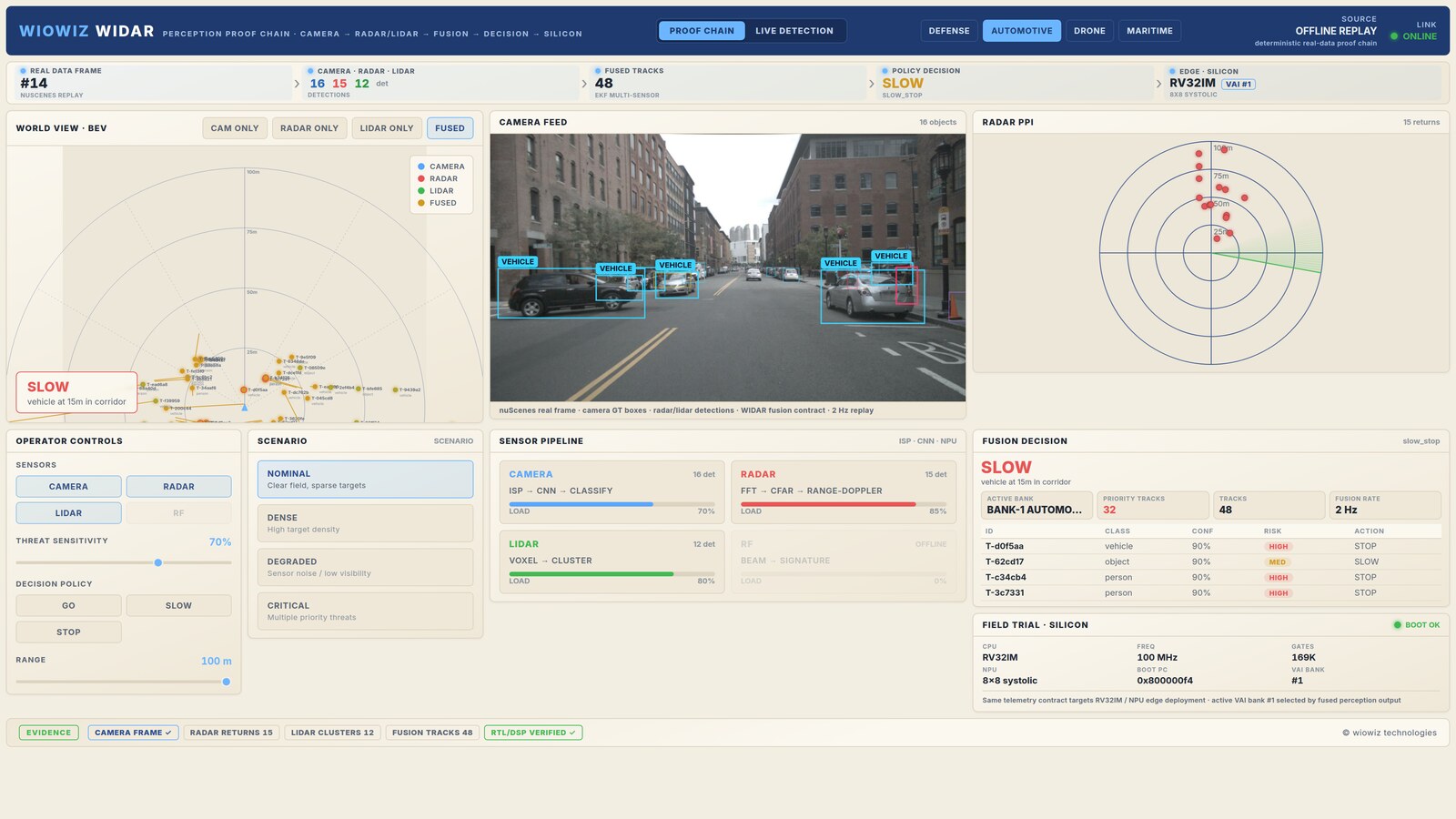
ADAS
Automotive perception for the edge cases that break single sensors: night, glare, occlusion and sensor blinding. Camera, radar and lidar into one driving decision.
Explore ADAS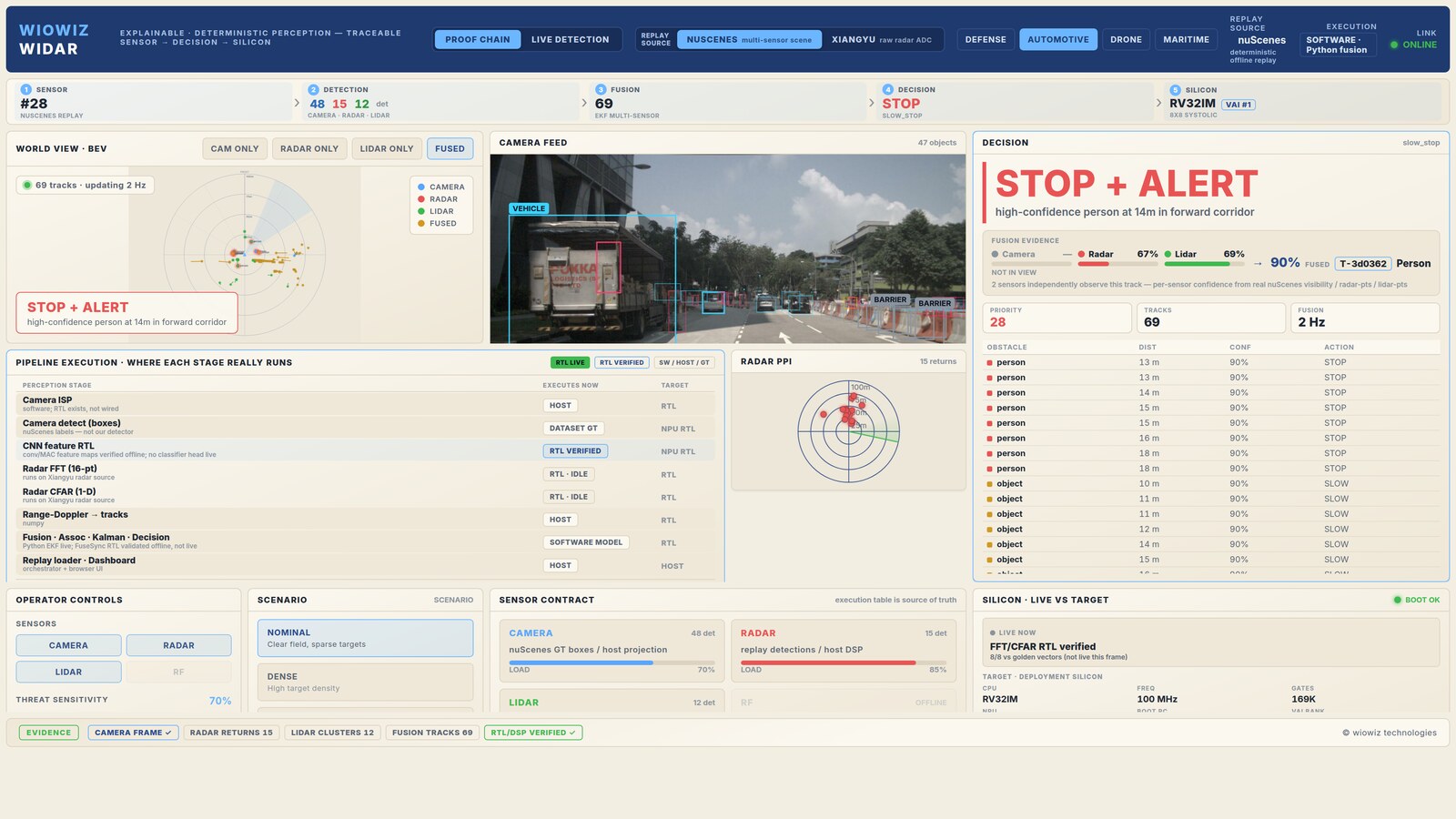
Drones and defense
Perception for the contested sky: detect across 360 degrees, hold the track through clutter and countermeasures, and drive a decision an operator can trust.
Explore defense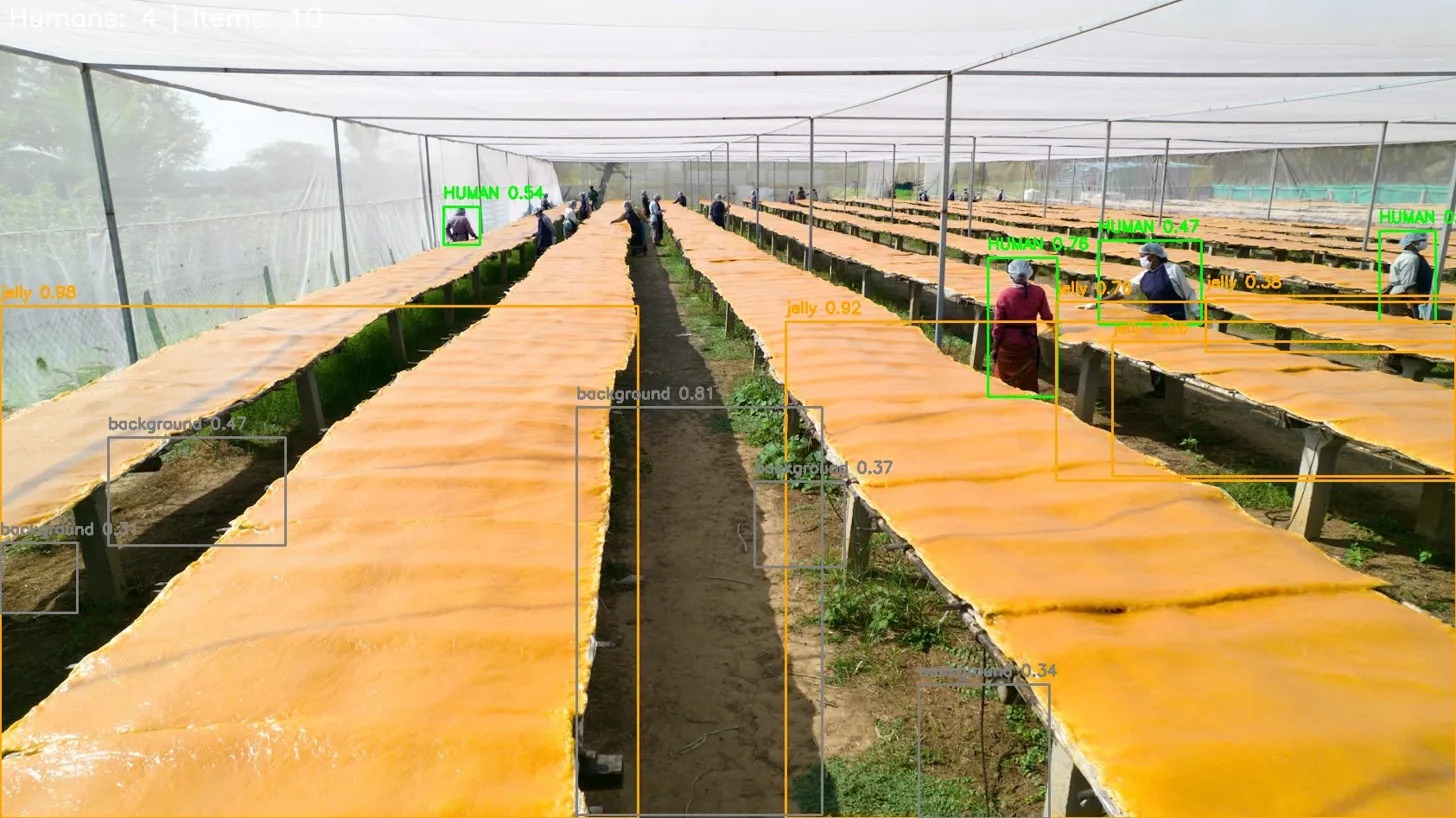
Agriculture
Perception from crop to quality, running today as DRIFT on a working food-processing line: detecting workers, tracking drying surfaces and scoring product quality.
Explore agriculture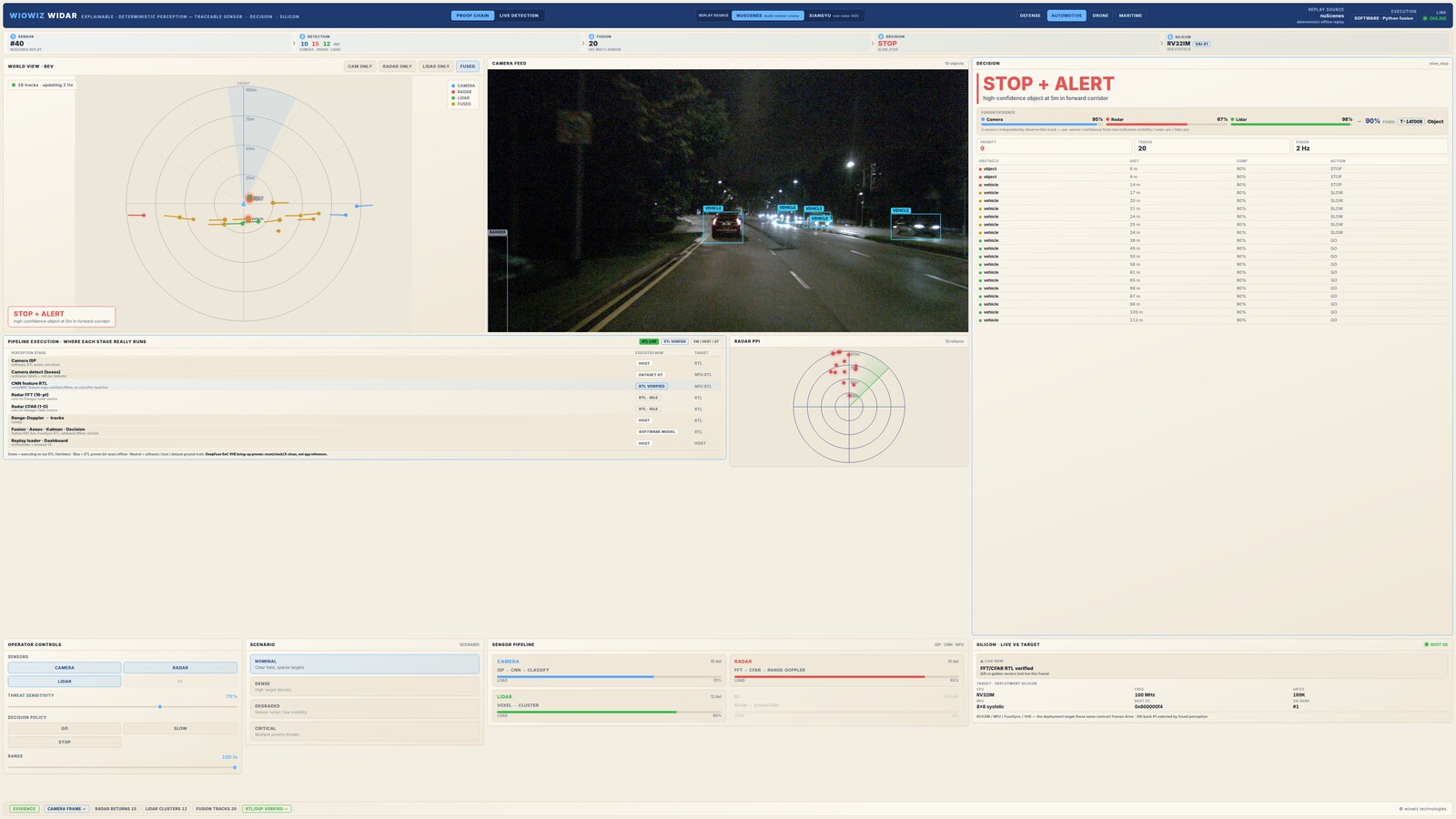
Physical robots
The same fusion core aimed at autonomous machines: mapping, obstacle tracking and decisions on the floor. In development, and open to design partners now.
Talk to usSoftware perception is common. WIOWIZ builds it in silicon.
What makes one core serve every front is the layer underneath it. In WIDAR, key perception stages do not just run in Python; they run bit-exact on WIOWIZ-designed RTL, checked frame by frame against golden reference vectors. One verified core, reused across robots, cars, drones and the field.
The path from any front to a power-and-latency-bounded edge device is a hardware path we already own, because we designed the accelerators, the DSP and the RISC-V control ourselves.
- Radar signal chain on our DSP RTL FFT, CFAR and range-Doppler, Verilated, bit-exact vs golden vectors.
- CNN feature extraction on our accelerator RTL Camera frames through a WIOWIZ CNN accelerator; feature maps verified bit-exact.
- RISC-V control at the edge An RV32IM core with an 8x8 systolic NPU as the deployment target for on-chip inference.
- One core, every front The same verified perception pipeline deploys across all four verticals.
Where the platform is going.
WIDAR runs a full fusion pipeline today with RTL-backed stages. From here we broaden the fronts, move onto live sensors, and stand up our own scenario simulation to train and validate perception at scale.
One fusion core, live fronts
Camera, radar and lidar fusion with RTL-verified stages, driving defense, ADAS and an agriculture deployment on a real line today.
Live sensors and the WIDAR Simulator
Bring every front onto live sensors, add physical robots, and build the WIDAR Simulator, our own scenario simulation to train and validate perception across worlds and edge cases.
On-chip inference everywhere
The full detect, track and decide loop on WIOWIZ silicon at the edge, one core shipped into every front within a fixed power and latency budget.
Bring WIDAR to your front.
We walk engineering teams through the fusion core, the RTL-verified stages, and what a path to your own edge silicon looks like, whichever front you are on. Not slideware: the stack running.