
Perception that runs in silicon, for the contested sky.
WIDAR fuses camera, radar and lidar into one real-time world-view, and runs it bit-exact on WIOWIZ's own RTL.
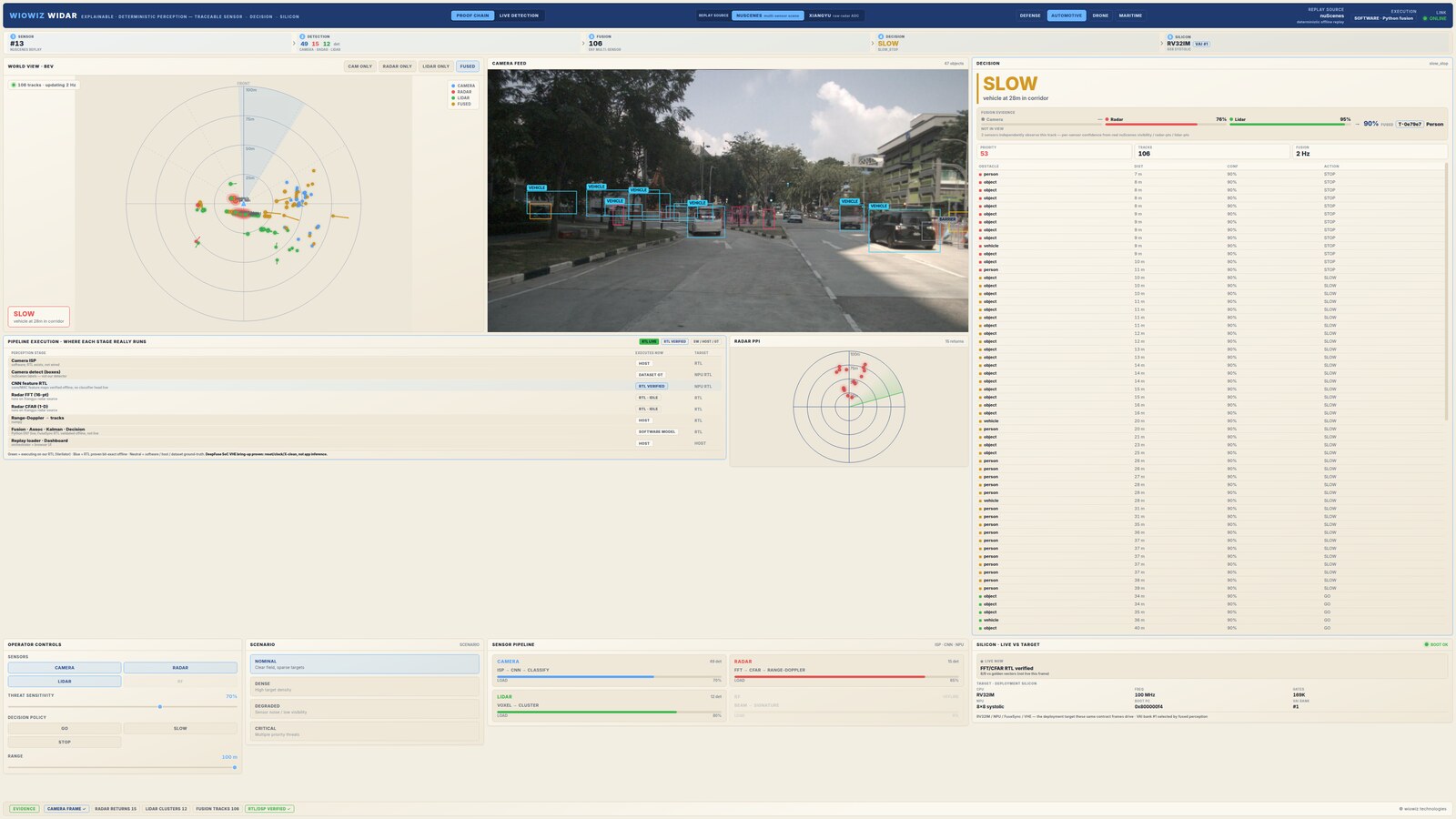
The loop above is camera frames driven through our own CNN accelerator RTL. WIDAR runs today on public datasets (nuScenes, Xiangyu radar), with radar DSP and CNN feature stages verified bit-exact against golden vectors on WIOWIZ-designed silicon.
Cheap drones. Dense clutter. Seconds to decide.
The contested sky is now crowded with low-cost drones and coordinated swarms: small, fast, and easy to lose in RF clutter or against a bright or dark background. Defeating them is three problems in one tight loop: detect across 360 degrees, hold the track through noise and countermeasures, and turn that picture into a decision an operator can trust. No single sensor covers all three on its own. WIDAR is built to close that loop.
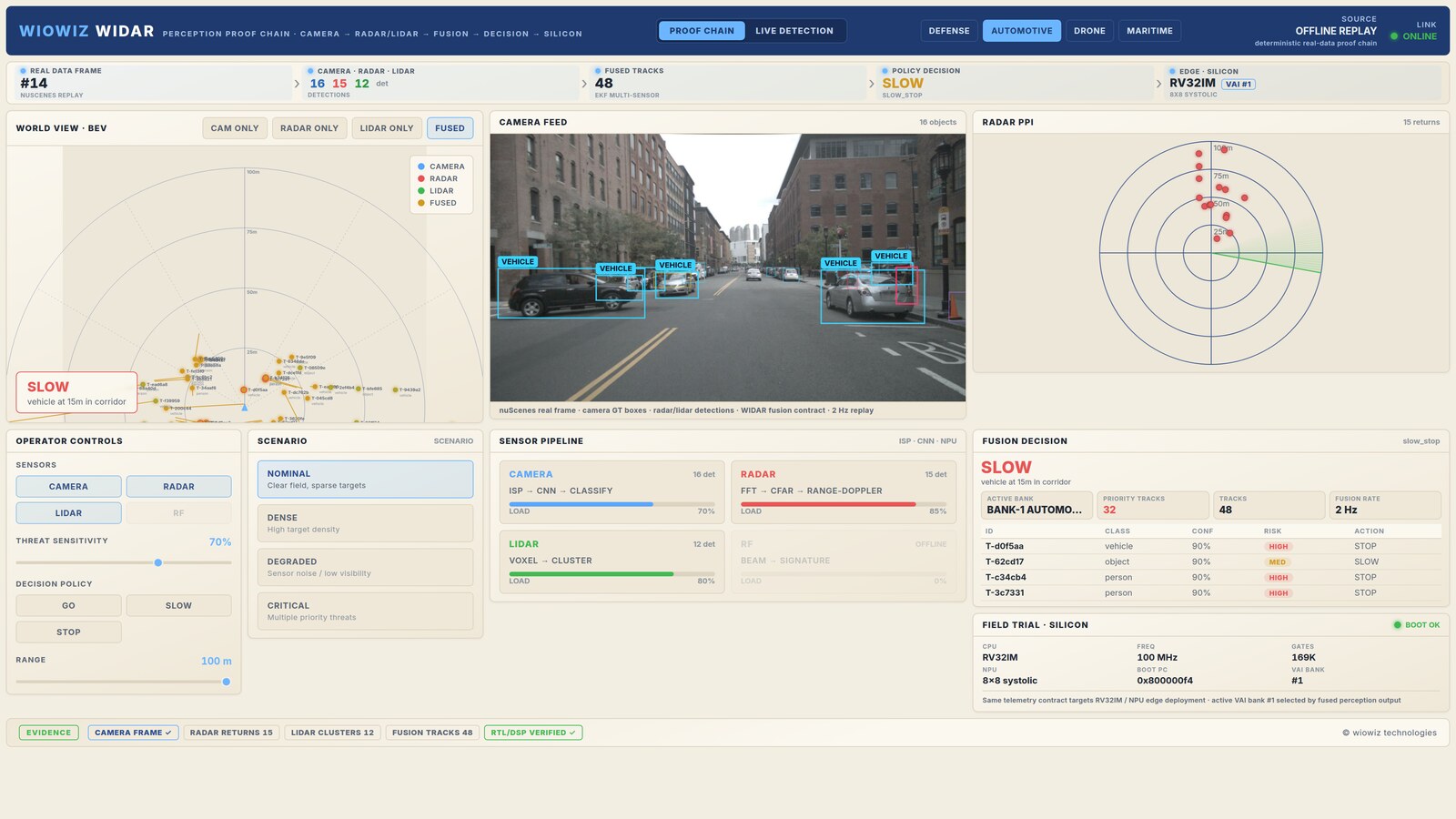
One world-view, fused from three senses.
WIDAR fuses camera, radar and lidar into a single bird's-eye world-view and one decision. Fusion is the point: where one sensor is defeated, the others carry the track. Camera gives class and shape but fails at night or when blinded. Radar sees through darkness and gives range and velocity but is coarse. Lidar gives precise 3-D structure. Combined and cross-checked, they degrade gracefully instead of failing hard.
Camera
Class and shape, with rich detail in good light. The first to fail at night, in glare, or when blinded.
Radar
Range and velocity through darkness, dust and weather. Coarse alone, decisive in fusion, and processed on our own DSP RTL.
Lidar
Precise 3-D structure and separation of close targets, anchoring the fused world-view in real geometry.
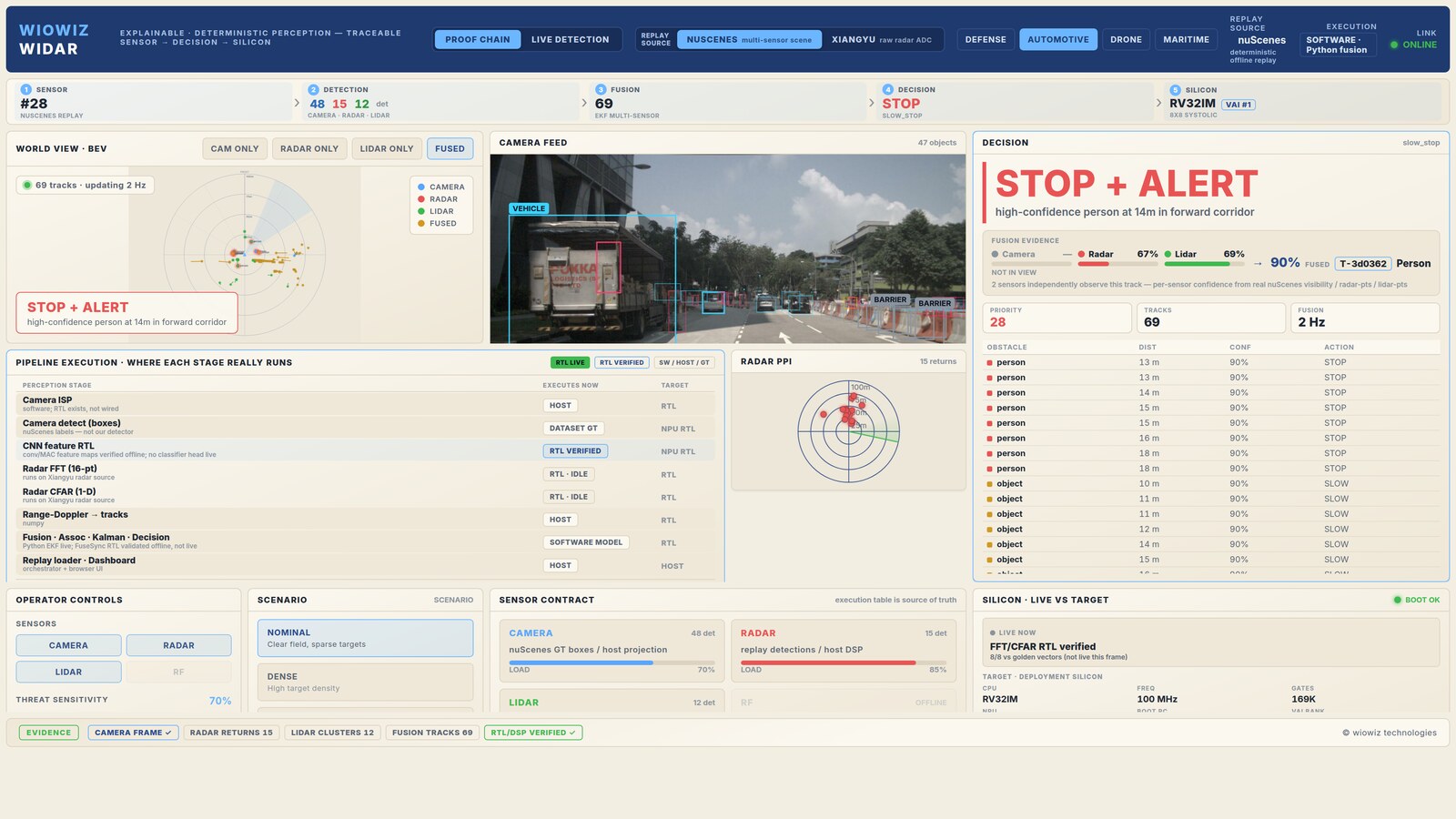
From sensors to a single decision
Each detection from each sensor is associated and tracked through a multi-sensor Kalman filter, then reduced to one operator picture: fused tracks, per-track confidence, and an explicit action per obstacle (GO / SLOW / STOP + ALERT). The pipeline is deterministic and traceable. Every stage in the chain reports where it actually ran, on host software or on RTL.
See the stack run.
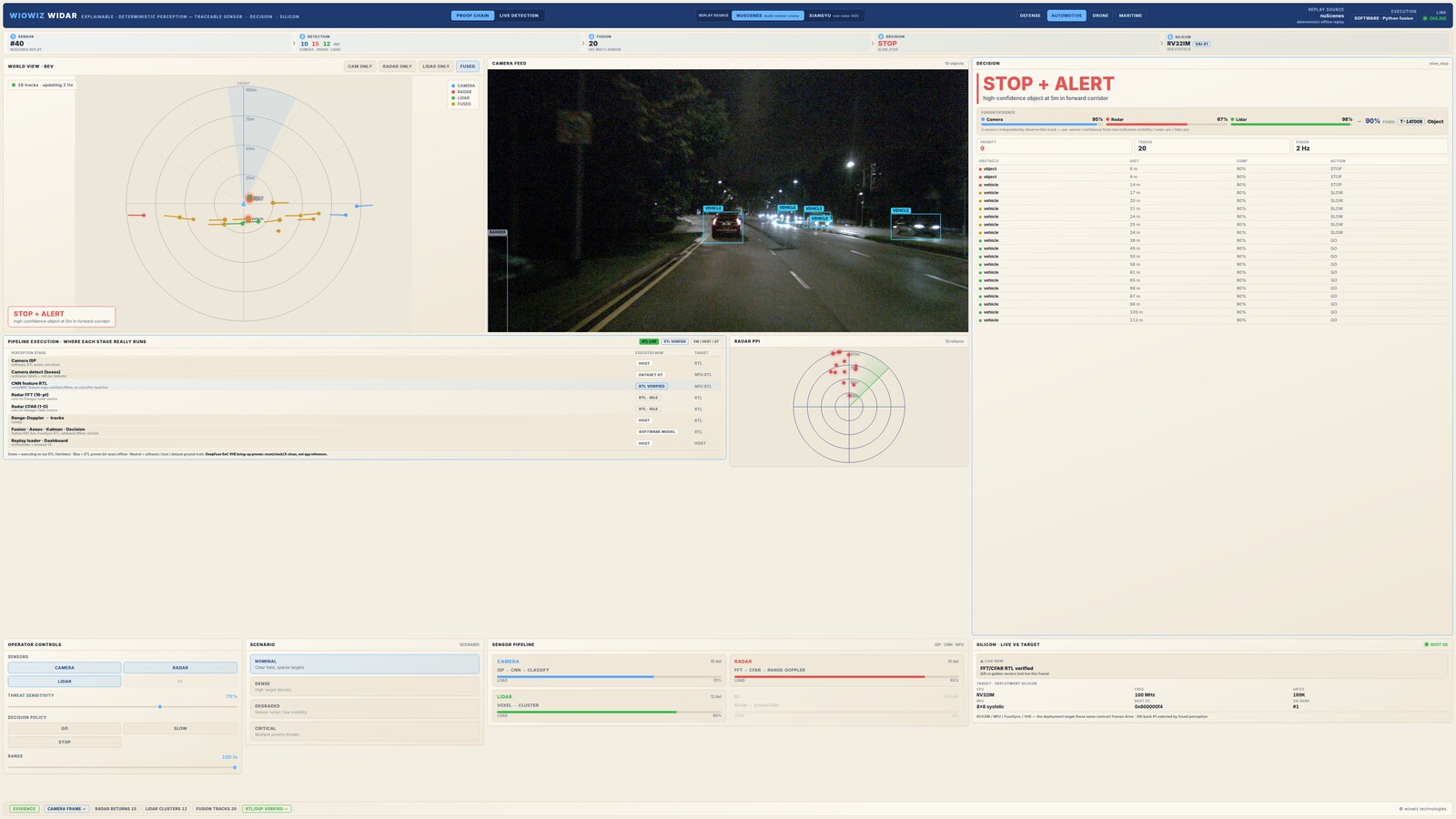
Every panel below is a screen from the WIDAR Command Center. Where a stage runs bit-exact on WIOWIZ RTL, we mark it. Tags are literal: RTL DATASET FUSION
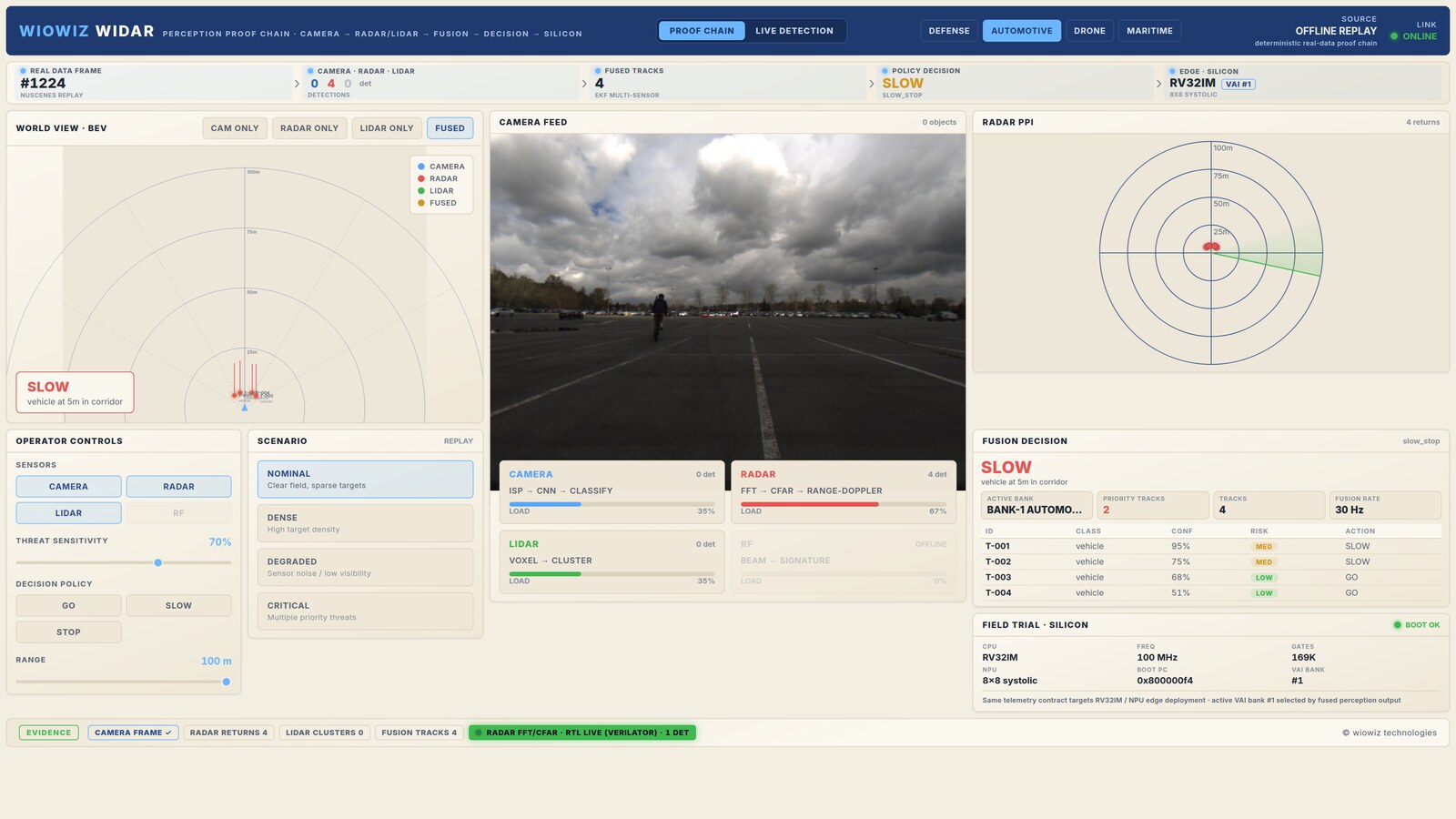
Radar, processed in our own silicon
Recorded radar (Xiangyu) runs through our FFT, CFAR and range-Doppler DSP on a Verilated RTL model, bit-exact against golden vectors. This is our hardware doing the signal processing, not a software stand-in.
Every track fused into one operator picture
Camera, radar and lidar detections fuse into a single bird's-eye view, here 69 tracks, reduced to one decision (STOP + ALERT) with per-track confidence. The panel labels each stage's execution target.
Detection on our own CNN accelerator RTL
Camera frames drive through WIOWIZ's own CNN accelerator RTL, frame by frame, with feature maps verified bit-exact versus the golden model. The classifier head is validated offline.
Camera blinded, radar and lidar hold the track
Two scenes. Left: camera, radar and lidar all feed the fusion. Right: the camera is dropped and radar and lidar alone continue to hold the tracks and drive the decision. This is graceful degradation, by design.
Software perception is common. WIOWIZ builds it in silicon.
Anyone can wire up an off-the-shelf model and call it perception. What is hard, and what WIOWIZ builds, is the silicon underneath it. In WIDAR, key perception stages do not just run in Python; they run bit-exact on WIOWIZ-designed RTL, checked frame by frame against golden reference vectors.
That means the path to a power-and-latency-bounded edge device is a hardware path we already own, because we designed the accelerators, the DSP and the RISC-V control ourselves.
- Radar signal chain on our DSP RTL FFT, CFAR and range-Doppler, Verilated, bit-exact vs golden vectors.
- CNN feature extraction on our accelerator RTL Camera frames through a WIOWIZ CNN accelerator; feature maps verified bit-exact.
- RISC-V control at the edge An RV32IM core with an 8x8 systolic NPU as the deployment target for on-chip inference.
- Deterministic, traceable pipeline Every stage reports its execution target, host software or RTL.
Where WIDAR is going.
WIDAR runs a full camera, radar and lidar fusion pipeline today, with RTL-backed stages driven by public datasets. Here is the ladder from here to an on-chip end-to-end system, without skipping steps.
Fusion and RTL perception
Camera, radar and lidar fusion into one world-view and decision. Radar DSP and CNN feature stages verified bit-exact on WIOWIZ RTL, driven by nuScenes and Xiangyu.
Live sensors and our own simulation
Bring the same fusion and decision pipeline onto live mmWave radar, lidar and camera, and stand up our own scenario simulation to train and validate perception at scale.
On-chip end-to-end inference
The full detect, track and decide loop, including the classifier head, running on WIOWIZ silicon at the edge within a fixed power and latency budget.
Request a WIDAR briefing.
We walk engineering teams through the pipeline, the RTL-verified stages, and what a path to your own edge silicon looks like. Not slideware: the Command Center running.